criminal defense lawyer NC: The Truth About ‘Unlawful Entry’
criminal defense lawyer NC explains why “unlawful entry” cases can collapse fast—and what to do in 24 hours to protect yourself. Se Habla Español.
Vasquez Law Firm
Published on December 23, 2025
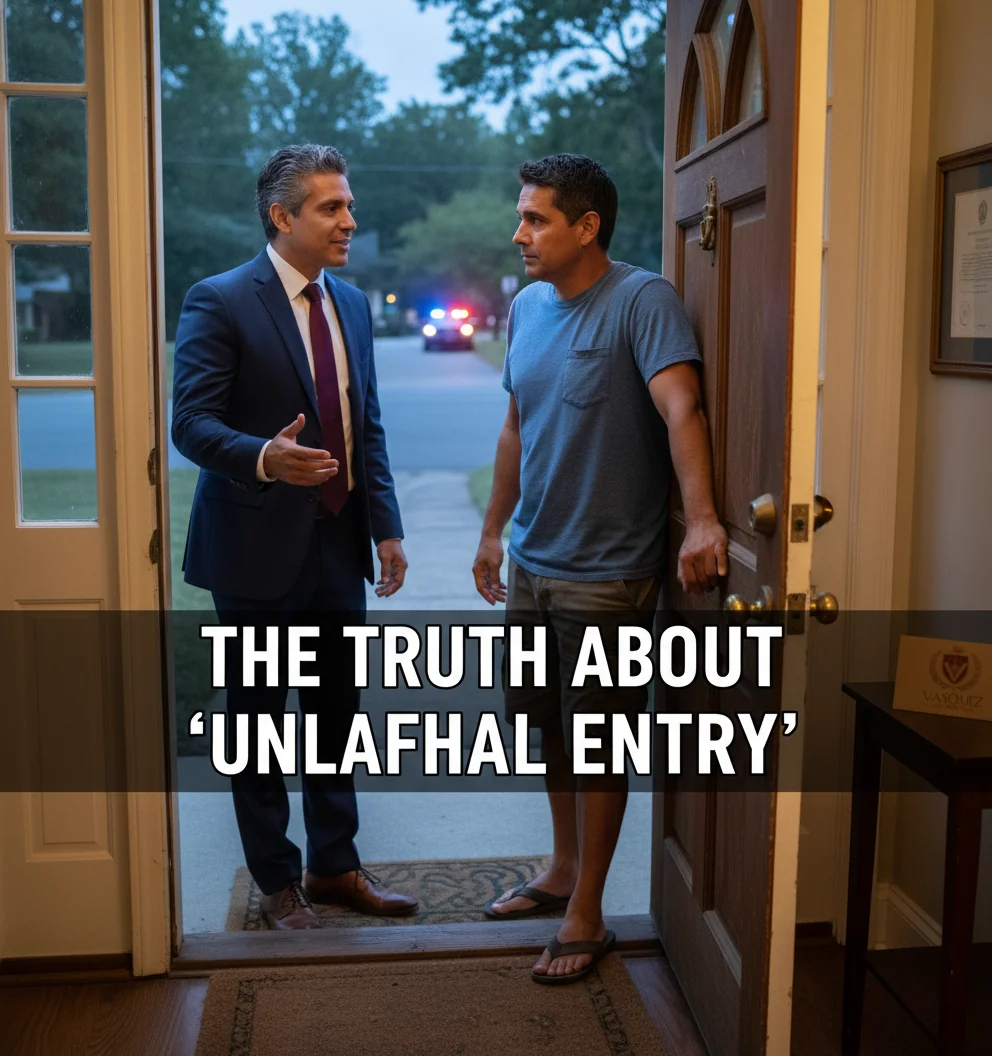
criminal defense lawyer NC: The Truth About ‘Unlawful Entry’
If you’re accused of “unlawful entry,” it can feel like the case is already over. But the recent news story about a Dubai court clearing a man accused of entering a rented villa shows a core truth: these cases often turn on permission, proof, and sloppy assumptions. A criminal defense lawyer NC will look for the same weak points North Carolina prosecutors must prove—especially when a rental, shared access, or a misunderstanding is involved.
Quick Summary (Read This First)
What happened: A court cleared a man accused of unlawful entry into a rented villa after the facts did not support the charge.
Why it matters to you: In North Carolina, many “trespass/breaking and entering” accusations hinge on whether you had consent, lawful access, or criminal intent—details that can be misunderstood or overstated.
What to do now: Preserve proof of permission (texts, lease, key history) and stop discussing the event with anyone except your lawyer.
What This News Means for North Carolina Residents
In the Dubai case, the key issue was not the label (“unlawful entry”)—it was whether the evidence actually proved the elements of the offense. You can read the coverage via this Gulf News report on the unlawful entry acquittal.
That same dynamic plays out in North Carolina when someone is accused of entering a home, apartment, rented property, or short-term rental without permission. These cases often start with a fast 911 call, fear, and incomplete information. By the time police arrive, the story can already be “locked in.”
1) “Unlawful entry” accusations often start with assumptions
Many conflicts involve people who once had access: an ex-partner, former roommate, family member, maintenance worker, or guest. In rentals, keys, door codes, and “who said what” can change quickly.
2) Permission (or lack of it) is usually the whole case
Consent can be direct (“come over”) or indirect (you have a key, you pay rent, you are on the lease). But consent can also be revoked. Whether it was revoked before entry—and whether you knew that—can be the difference between a charge and a dismissal.
3) The charge in North Carolina may not be called “unlawful entry”
In North Carolina, similar accusations are commonly charged as:
- First-degree trespass (often for entering/remaining after being told not to) under N.C. Gen. Stat. § 14-159.12.
- Second-degree trespass (including certain “no trespass” situations) under N.C. Gen. Stat. § 14-159.13.
- Breaking or entering under N.C. Gen. Stat. § 14-54 when the state alleges an unlawful entry and intent to commit a felony or larceny inside.
What to Do in the Next 24-48 Hours
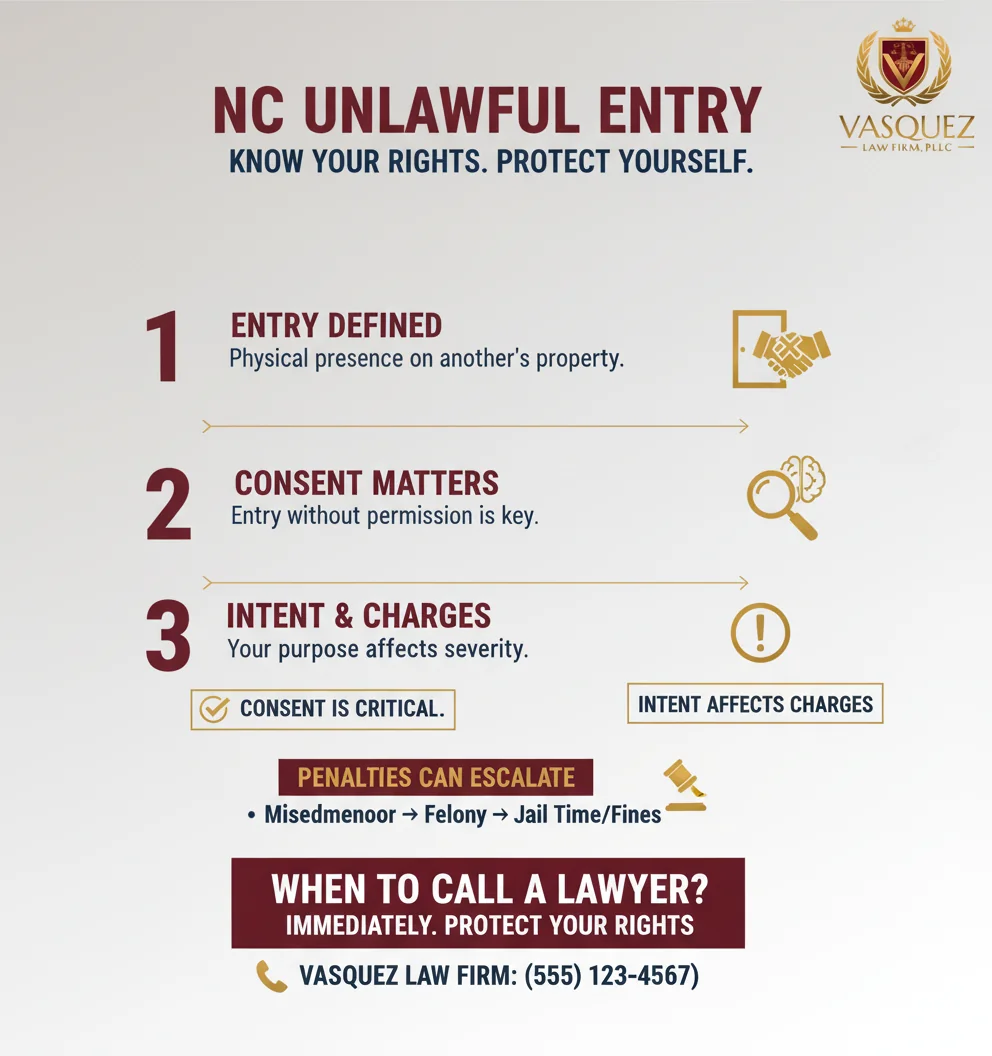
If this situation applies to you, take these steps NOW:
- Step 1: Document permission and access: screenshots of texts/calls, lease pages, emails with the landlord, door-code logs, and any messages about entry.
- Step 2: Write a timeline while it’s fresh: where you were, why you went, who invited you, how you entered, and who was present.
- Step 3: Do not “explain it” to police or the complainant to fix it—extra statements often create new inconsistencies.
- Step 4: Consult with a legal expert to understand your rights and options
KEY TAKEAWAY:
In “entry” cases, the first story police hear often shapes the entire investigation. Preserving proof of consent and staying silent can prevent a weak accusation from turning into a stronger case.
Warning Signs & Red Flags to Watch For
These are signs your case may be in jeopardy:
- The complainant says you were “never allowed there,” but you have a key, code, lease interest, or prior written permission.
- Police claim you “forced entry” even though there is no real damage or the door was unlocked.
- The allegation suddenly grows into “breaking and entering” or “intent to steal” with no proof of intent.
Seeing these signs? Vasquez Law Firm, PLLC has handled hundreds of denied claims in North Carolina. Attorney Vasquez knows the tactics insurers use. Get a free case evaluation.
Your Rights: What You CAN and CANNOT Do
YOU HAVE THE RIGHT TO:
- Remain silent and decline to answer investigative questions beyond identifying information.
- Ask for a lawyer before any interview or written statement (including “just to clear things up”).
- Challenge the evidence (including body-cam footage, witness credibility, and alleged damage).
YOU CANNOT:

- Contact the complainant if a no-contact order or release condition prohibits it.
- Assume “it’s just a trespass” and ignore court dates—missed dates can lead to an order for arrest.
Vasquez Law Firm, PLLC helps North Carolina clients understand and protect their rights every day.
Documents You'll Need (Save This Checklist)
Gather these documents NOW (before they disappear):
- Lease, sublease, addendum, or any written permission to stay/enter (including short-term rental confirmations).
- Texts, emails, DMs, or call logs showing invitation, access, or ongoing permission.
- Photos/video of the door, lock, and any alleged damage (take close and wide shots).
- Key or code history: who issued it, when it was changed, and who else had access.
- Witness contacts who saw you arrive/leave or heard the permission conversation.
Tip: Keep all documents organized in one folder - it makes the process much easier.
Legal Background and Context
“Unlawful entry” is a broad phrase. In practice, the state usually files trespass or breaking/entering charges depending on the facts. Understanding the difference matters, because the required proof is different.
Trespass vs. breaking/entering in North Carolina
Trespass generally focuses on being somewhere you were not allowed to be (or staying after being told to leave). See N.C. Gen. Stat. § 14-159.12 and § 14-159.13 on the North Carolina General Assembly statutes site.
Breaking or entering under N.C. Gen. Stat. § 14-54 often requires proof of entry without consent and intent to commit a felony or larceny inside. Intent is frequently where cases weaken, especially when nothing was taken and there is an innocent explanation for being there.
Why consent, notice, and “I didn’t know” can matter
In many rental disputes, people argue about whether permission was revoked and when. Practical questions often decide the case:
- Were you told clearly to stay away (in writing or in front of witnesses)?
- Was there a posted “No Trespassing” notice or prior notice from an owner/tenant?
- Did you have a reasonable belief you still had permission (key, code, ongoing tenancy, shared bills)?
Procedural protections: court dates, conditions, and records
After an arrest or citation, your next steps often involve conditions of release and future court settings. To confirm your court date and courthouse rules, use the official North Carolina Judicial Branch website.
Also know this: statements you make early (to police, a landlord, a property manager, even a “helpful” neighbor) can be used later. That’s why experienced defense counsel will ask for discovery, review body-cam, and test the complainant’s timeline before you lock yourself into a version of events.
How Vasquez Law Firm, PLLC Helps North Carolina Clients Win These Cases
Entry-related accusations can escalate quickly—from a misunderstanding to criminal charges that affect housing, employment, and immigration status. A criminal defense lawyer NC focuses on evidence, intent, and credibility from day one. At Vasquez Law Firm, PLLC, our team is led by Attorney Vasquez, JD (15 years of experience; admitted to the North Carolina State Bar and Florida Bar). Se Habla Español.
Our approach in “unlawful entry” style cases
We tailor the defense to the charge and the story, but the core tasks are consistent:
- Evidence control: preserve texts, leases, door photos, and identify witnesses before memories fade.
- Discovery review: analyze police reports, body-cam, 911 recordings, and prior statements for contradictions.
- Element-by-element attack: challenge consent, notice, and the state’s proof of intent (especially for N.C. Gen. Stat. § 14-54 allegations).
- Outcome planning: seek dismissal/reduction when proof is thin; prepare for trial when necessary.
Where these cases usually break (and why that matters)
In our experience, “unlawful entry” allegations often weaken when:
- The complainant exaggerates “forced entry,” but photos show no damage.
- The timeline doesn’t match door-code logs, GPS data, or witnesses.
- Police treat a civil landlord-tenant conflict like a criminal case without confirming who had lawful access.
Real example: “We represented a client accused of entering a former partner’s apartment after a breakup. The complainant told police he ‘broke in,’ but photos showed no forced entry and texts showed prior permission to retrieve property. After presenting the documentation and highlighting inconsistencies, the charge was reduced and later dismissed after compliance with court conditions.” - Attorney Vasquez
If you are searching for a criminal defense lawyer NC, it’s critical to choose someone who understands how quickly an entry allegation can become a record—and how to stop that early.
Learn more about our Criminal Defense services and the types of cases we handle across North Carolina.
Frequently Asked Questions (Specific to This Situation)
These questions come up after people read stories like the Dubai unlawful-entry acquittal and wonder what happens if a rental or access dispute turns criminal in North Carolina.
If I had a key or door code, can I still be charged in North Carolina?
Yes. Having a key/code is helpful evidence of permission, but it is not a complete shield if the state claims permission was revoked and you knew it. The defense often focuses on timing (when consent was revoked), notice (how you were told), and reasonableness (why you believed you could enter).

What if I’m on the lease, but my roommate says I’m “not allowed” to enter?
Lease status matters. If you are a lawful tenant, a roommate generally cannot unilaterally convert your lawful access into “unlawful entry” without legal process—though there are exceptions in domestic violence contexts and situations involving court orders. Bring the lease and any court paperwork to your lawyer immediately.
How does the state decide between trespass and breaking/entering?
Often it depends on the allegation of intent. Trespass (N.C. Gen. Stat. §§ 14-159.12 and 14-159.13) centers on permission and notice. Breaking/entering (N.C. Gen. Stat. § 14-54) adds the idea that you entered intending to commit a felony or larceny inside. Prosecutors may file the higher charge if they believe it gives them leverage, even when intent is weak.
Can a landlord-tenant dispute turn into a criminal charge?
It can. For example, if an eviction is pending and emotions run high, one side may call police. Sometimes law enforcement gets pulled into what is mainly a civil dispute. The outcome often turns on documentation: lease terms, notices, lock-change history, and any prior police reports.
Should I request body-cam video if police responded?
Yes, but do it through counsel. Body-cam and 911 audio can capture crucial details: whether the door was damaged, what the complainant said in the moment, and whether you appeared confused rather than criminal. A criminal defense lawyer NC can request and analyze discovery and preserve the record for court.
Does it matter if my case is in Wake County vs. Mecklenburg County?
The statutes are statewide, but local charging practices, diversion options, and courtroom scheduling can vary. Your strategy should account for the local district attorney’s approach and the courthouse calendar. Checking your date and courtroom through the North Carolina Courts site helps prevent missed appearances.
What if there’s a protective order or no-contact order and I entered to get my belongings?
This is high risk. Even if you believe you had a good reason, a no-contact or “stay away” order can make entry itself a violation, separate from trespass. Do not attempt self-help. Your lawyer can ask the court for a structured property retrieval process or modifications to avoid new charges.
Don't Navigate This Alone
If you're dealing with a trespass, breaking and entering, or “unlawful entry” accusation tied to a rental or access dispute, Vasquez Law Firm, PLLC can help. With 15+ years serving North Carolina, we know what works.
Free consultation. Bilingual team. No fees unless we win.
Call Now: 1-844-967-3536
Se Habla Español - Hablamos Su Idioma
Free Legal Consultation
Discuss your case with our experienced attorneys. We're available 24/7.
Vasquez Law Firm
Legal Team
Our experienced attorneys at Vasquez Law Firm have been serving clients in North Carolina and Florida for over 20 years. We specialize in immigration, personal injury, criminal defense, workers compensation, and family law.