divorce lawyer NC: WARNING—Judge Resigns, Records at Risk
Divorce lawyer NC insight after a judge resigns over record tampering—learn how to protect your filings and custody evidence. Se Habla Español.
Vasquez Law Firm
Published on December 23, 2025
divorce lawyer NC: WARNING—Judge Resigns, Records at Risk
If you’re hiring a divorce lawyer NC families trust, here’s the uncomfortable truth: your case can rise or fall on paperwork and court records. A recent news story about a judge resigning after being charged with records tampering is a reminder that documentation, timestamps, and certified copies matter—especially when money, custody, and credibility are on the line.
Quick Summary (Read This First)
What happened: A judge resigned after being charged with records tampering, raising public concerns about the integrity of court files and case documentation.
Why it matters to you: Divorce cases depend on accurate records—filings, financial disclosures, custody orders, and hearing dates—and small “paper problems” can create big legal risk.
What to do now: Keep your own file, confirm what was filed, and get certified copies of key orders and agreements as soon as they’re entered.
What This News Means for North Carolina Residents
News about court record tampering is unsettling. Even when the story happens outside North Carolina, it highlights a reality that applies everywhere: courts run on records. In divorce, the “record” is not just your story. It’s what you can prove and what is actually filed.
In the reported resignation and charges, the allegation involved improper handling of court records. You can read the coverage through this Marshall Project coverage shared via Google News.
Why court records matter in NC divorce
When people search for a divorce lawyer NC, they’re usually worried about custody, support, the house, and retirement accounts. But the foundation is the paperwork: who filed what, when it was served, what financial documents were produced, and what the judge actually ordered.
- Custody: A small detail—like the exact wording of a temporary order—can change what you can enforce.
- Support: Dates matter for when obligations start and how arrears are calculated.
- Property division: Your “date of separation” and documented property values can drive the final result.
What North Carolina residents should take from this
This news is not a reason to panic. It is a reason to be organized and proactive. In North Carolina family court, the best protection is a clean paper trail: saved emails, clear timelines, and copies of everything you filed or received.
A practical way to think about it
Assume that, months from now, you may need to prove one simple fact: “This was filed,” “This was served,” or “This order says X.” If you can’t prove it, the court may not treat it as real—even if you remember it perfectly.
What to Do in the Next 24-48 Hours
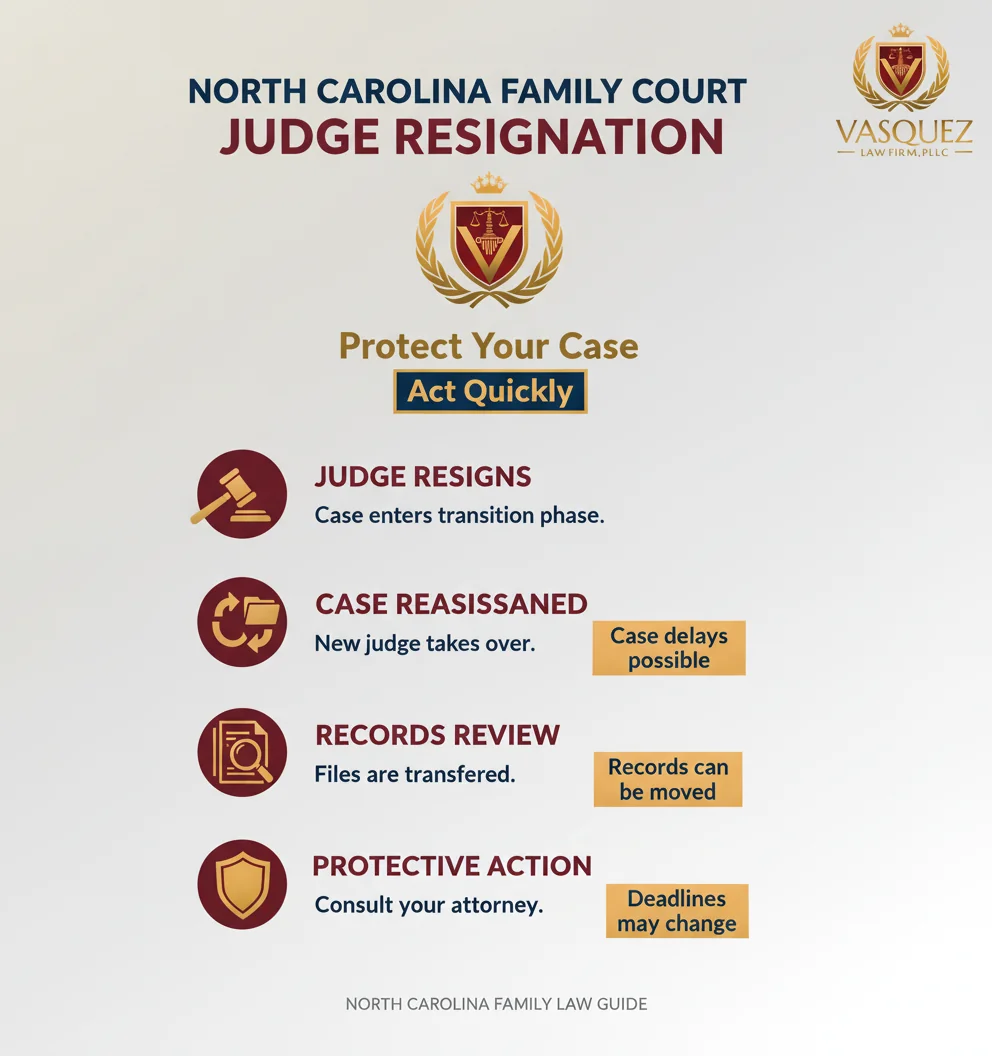
Whether you are just separating or already in litigation, the next day or two is the right time to tighten your process. These steps are about reducing risk and increasing clarity.
1) Stabilize your case file
Create a single folder system (digital + paper). Use simple names like “2025-12-Temporary-Custody-Order.pdf.” If you’re working with a divorce lawyer NC clients rely on, you’ll be asked for this anyway—doing it now saves time and cost.
2) Verify filing and service basics
Many divorce problems are not “legal” problems—they are filing and service problems. Confirm that pleadings were filed with the clerk and that service happened the right way, in the right timeframe, with proof.
3) Lock down key evidence
Download and back up bank statements, tax returns, retirement statements, and communication that relates to custody or finances. Keep originals intact. Avoid altering documents or metadata.
If this situation applies to you, take these steps NOW:
- Step 1: Document everything—save emails/texts, screenshot important messages, and write down dates, hearing info, and who said what.
- Step 2: Pull your court history: get file-stamped copies of key pleadings and confirm the current hearing calendar and deadlines.
- Step 3: Do NOT sign a separation agreement or consent order until you confirm it matches what you intend and what was discussed.
- Step 4: Consult with a legal expert to understand your rights and options
Warning Signs & Red Flags to Watch For
Most divorce cases in North Carolina are handled ethically and correctly. But “record problems” can happen for many reasons: miscommunication, missing attachments, wrong versions, or confusion about what the judge ordered. Pay attention to these red flags early.
Red flags in court paperwork
If anything feels “off,” slow down and verify. Court systems are busy, and errors can snowball.
Red flags with the other spouse (or their lawyer)
Not every aggressive move is improper. But certain patterns suggest you should document carefully and get guidance.
Red flags with temporary orders
Temporary custody/support orders can shape the final outcome. Confusion about what is in effect can cause violations you never intended.
These are signs your case may be in jeopardy:

- You’re told “the court has it” but nobody can provide a file-stamped copy or a signed order.
- A hearing date “moves” without a written notice, or you learn about changes secondhand.
- You see different versions of the same agreement/order floating around, with different terms or missing exhibits.
Seeing these signs? Vasquez Law Firm, PLLC has handled hundreds of denied claims in North Carolina. Attorney Vasquez knows the tactics insurers use. Get a free case evaluation.
Your Rights: What You CAN and CANNOT Do
Divorce is stressful, and it’s easy to act on fear. The better path is to know what the law allows—and what can backfire. A divorce lawyer NC families hire will often start here: keep you protected while building your case the right way.
What you CAN do to protect yourself
You can create a record that is clean, lawful, and persuasive without escalating conflict.
What you CANNOT do (even if you feel justified)
Some actions can harm custody or expose you to criminal or civil consequences, even during a painful separation.
How to handle concerns about court records
If you suspect an error in an order, a missing filing, or a mismatch between what was said in court and what was entered, the solution is typically a formal request, motion, or clarification—done through the proper channels.
YOU HAVE THE RIGHT TO:
- Request and keep copies of your filed pleadings, signed orders, and the court calendar for your case.
- Ask the court for clarification or correction when an order has an error (for example, the wrong date, name, or missing provision).
- Present evidence about finances and parenting—including documents, witnesses, and timelines—so the judge can make informed decisions.
YOU CANNOT:
- Change or “fix” court documents yourself—only the court can enter, amend, or replace orders.
- Ignore an order because you believe it’s unfair; until it is modified, it is enforceable.
Vasquez Law Firm, PLLC helps North Carolina clients understand and protect their rights every day.
Documents You'll Need (Save This Checklist)
In a divorce, the strongest cases are usually the best-documented cases. If the news makes you nervous about record integrity, the solution is simple: keep your own “shadow file” with reliable copies.
Must-have court documents
These prove what was filed, when it was filed, and what the judge ordered.
Must-have financial documents
These support support claims and equitable distribution positions.
Must-have parenting documents (custody cases)
These help you show stability, involvement, and the child’s best interests.
Gather these documents NOW (before they disappear):
- File-stamped copies of your complaint, answer, motions, and any separation agreement drafts you exchanged.
- Signed temporary orders and final orders (custody, support, DVPO, attorney’s fees)—plus any exhibits attached.
- Bank and credit card statements (12–24 months), retirement statements, mortgage statements, and vehicle loan payoff info.
- Tax returns (last 2–3 years), W-2s/1099s, pay stubs, and proof of health insurance costs for the child.
- A parenting calendar: school events, medical appointments, extracurriculars, and overnights.
Tip: Keep all documents organized in one folder - it makes the process much easier.
KEY TAKEAWAY:
In divorce, “what happened” matters—but “what is in the court file” often matters more. Keep file-stamped copies and signed orders so you can prove timelines, terms, and compliance.
Legal Background and Context
Divorce in North Carolina is shaped by statutes and local court rules. The best source for procedures, forms, and court operations is the judiciary website: North Carolina Judicial Branch (NC Courts). That site helps you locate your county courthouse, learn basic processes, and understand how court administration works.
No-fault divorce and the paper trail
Most people think of divorce as one moment. In reality, it is a series of filings. North Carolina’s absolute divorce is often based on a one-year separation requirement (with limited exceptions). That means dates, addresses, and proof of separation can become important if the other side disputes them.
Equitable distribution, custody, and support depend on documentation
Property division (equitable distribution) is about identifying, classifying, valuing, and distributing assets and debts. Those steps require documents. Custody decisions focus on a child’s best interests, and judges look at patterns—again, proven with records.
What to do if you think the record is wrong
If an order is unclear or incorrect, the solution is not informal “fixes.” Common options include requesting a certified copy, checking the clerk’s file, and if needed, filing a motion to correct, clarify, or modify. The right approach depends on whether the issue is a clerical mistake, a missing exhibit, or a substantive disagreement about what the court decided.

For the text of statutes (including family law provisions), you can also review the official state code library at North Carolina General Statutes (NCGA).
How Vasquez Law Firm, PLLC Helps North Carolina Clients Win These Cases
When headlines raise concerns about record integrity, the practical response is strong lawyering: tight documentation, careful filing, and courtroom-ready evidence. That is the day-to-day work of a divorce lawyer NC families hire when the outcome matters.
How we build a clean, court-ready file
Our process is designed to reduce surprises. We create timelines, preserve communications, and make sure the court’s file matches what happened.
How we handle disputes over “what was filed”
If the other side claims a document was never received or an order says something different, we focus on verifiable proof: file stamps, service records, and signed orders.
Why experience matters
Attorney Vasquez, JD, has 15 years of experience and is admitted to the North Carolina State Bar and the Florida Bar. Our team serves North Carolina residents and offers bilingual support—Se Habla Español.
Our experienced team, led by Attorney Vasquez, has helped hundreds of North Carolina clients. Here's exactly how we help:
- Step 1: We review your case for free and tell you honestly if you have a claim
- Step 2: We handle all paperwork and deadlines so nothing gets missed
- Step 3: We fight insurance tactics - we know their playbook
- Step 4: We maximize your settlement or take it to hearing if needed
Real example: “A parent came to us after a tense separation. The other side claimed a temporary schedule existed and accused our client of violating it—but could not produce a signed order. We obtained the file, confirmed what had (and had not) been entered, organized a clear timeline with messages and school records, and presented the issue to the court. The judge clarified the temporary plan in writing and our client avoided contempt exposure while moving toward a stable custody order.” — Attorney Vasquez
If you want to learn more about our broader work in this area, see our Family Law services page.
Frequently Asked Questions (Specific to This Situation)
Because this news involves alleged records tampering and a judge’s resignation, people often worry about whether their own court file is accurate, complete, and enforceable—especially in custody and support matters.
Record integrity and checking your file
- Tip: Ask for file-stamped copies and signed orders. Keep them in your own folder.
- Tip: If something seems missing, verify with the clerk’s office and your attorney before a hearing.
Orders, enforcement, and contempt risk
- Tip: Don’t assume an agreement is enforceable unless it is properly executed and/or entered as an order when required.
Practical next steps in a North Carolina divorce
- Tip: Make sure your separation date, financial snapshots, and custody routine are documented early.
- If I’m in a North Carolina divorce, how do I confirm the court has the same order I have?
Start by comparing your copy to the signed version on file. Look for the judge’s signature, the date, and the file stamp. If you only have an unsigned draft, treat it as not final. - What if my spouse claims a “new” version of our custody order exists after I read about record tampering in the news?
Ask for the signed, file-stamped order number and date. If there is a dispute, your attorney can request the official copy from the clerk and, if needed, ask the court to clarify which order controls. - Can I get a certified copy of my divorce judgment or custody order in North Carolina for school or travel purposes?
Yes, certified copies are commonly available through the clerk’s office. Schools and agencies often want certified copies because they carry a seal and reduce disputes about authenticity. - What should I do if a hearing notice or deadline seems to “disappear” from the online system?
Don’t rely on memory or informal messages. Confirm the calendar directly and keep screenshots/notes of what you see. If there is a conflict, raise it quickly through your attorney so the court can address notice and due process concerns. - If my ex says I violated an order, but I never received a signed copy, can I still be held in contempt?
Contempt generally depends on a clear, valid court order and proof you had notice of it. If notice or the order’s terms are unclear, that can be a key defense—but you should treat the allegation seriously and gather proof of what you received and when. - Does it matter which courthouse my case is in (like Mecklenburg vs. Wake) for how records are handled?
Core statutes are statewide, but local practices can differ. For example, filing methods, courtroom calendars, and how quickly orders are entered can vary. It’s smart to learn the local process and keep your own organized file either way (for example, if you’re near the Mecklenburg County Courthouse in Charlotte or the Wake County Justice Center area in Raleigh).
Don't Navigate This Alone
If you're dealing with court record disputes, missing filings, or confusion about which divorce or custody order is enforceable, Vasquez Law Firm, PLLC can help. With 15+ years serving North Carolina, we know what works.
Free consultation. Bilingual team. No fees unless we win.
Call Now: 1-844-967-3536
Se Habla Español - Hablamos Su Idioma
Free Legal Consultation
Discuss your case with our experienced attorneys. We're available 24/7.
Vasquez Law Firm
Legal Team
Our experienced attorneys at Vasquez Law Firm have been serving clients in North Carolina and Florida for over 20 years. We specialize in immigration, personal injury, criminal defense, workers compensation, and family law.