Immigration Lawyer: WARNING—DHS Ends H-1B Lottery Shock
Immigration lawyer insight on DHS ending the H-1B lottery: who’s at risk, what North Carolina workers and employers should do next. Se Habla Español.
Vasquez Law Firm
Published on December 23, 2025
Immigration Lawyer: WARNING—DHS Ends H-1B Lottery Shock
If you rely on the H-1B program, this headline is the kind that can change a career overnight. An immigration lawyer can help you understand what “ending the lottery” may mean in real life—especially for North Carolina workers, students, and employers who are planning around cap season.
Quick Summary (Read This First)
What happened: Reports say DHS could change H-1B selection rules, including moving away from the traditional lottery-style selection for cap cases.
Why it matters to you: A new selection method can shift who gets picked, how employers file, and how fast you should build a backup plan—impacting North Carolina employers and foreign nationals planning start dates.
What to do now: Confirm your current status and expiration dates, map alternatives (cap-exempt, STEM OPT, L-1, O-1, TN, etc.), and keep documentation ready for fast filing.
What This News Means for North Carolina Residents
Why this DHS H-1B headline is a big deal
H-1B planning has always been difficult because cap selection was uncertain. The new wave of proposed changes—and the talk of ending the lottery—adds a new kind of uncertainty: not just whether you’re selected, but how selections are made and what employers must prove.
Here’s the news context discussed in the CNBC-TV18 coverage summarized in Google News.
Who in North Carolina feels this first
In North Carolina, the immediate impact tends to hit three groups:
- F-1 students on OPT/STEM OPT who need an H-1B start date to keep working without gaps.
- Employers (tech, healthcare, manufacturing, universities) who recruit nationally and globally.
- H-1B families thinking about travel, extensions, job changes, or green card timelines.
If you live near Charlotte, Raleigh, Durham, Cary, or Greensboro, you’ve likely seen how many roles depend on predictable work authorization timelines. This is why working with an immigration lawyer early can reduce avoidable delays.
What “ending the lottery” could mean (practical view)
Without speculating about final policy details, the practical point is this: selection mechanics shape employer behavior. If a new system prioritizes certain wages, job types, compliance history, or documentation quality, then preparation becomes even more important than luck.
For workers, that can affect:
- Whether your employer chooses to register you at all
- How your offered wage and job level are structured
- Whether a cap-exempt alternative becomes the safer route
What to Do in the Next 24-48 Hours
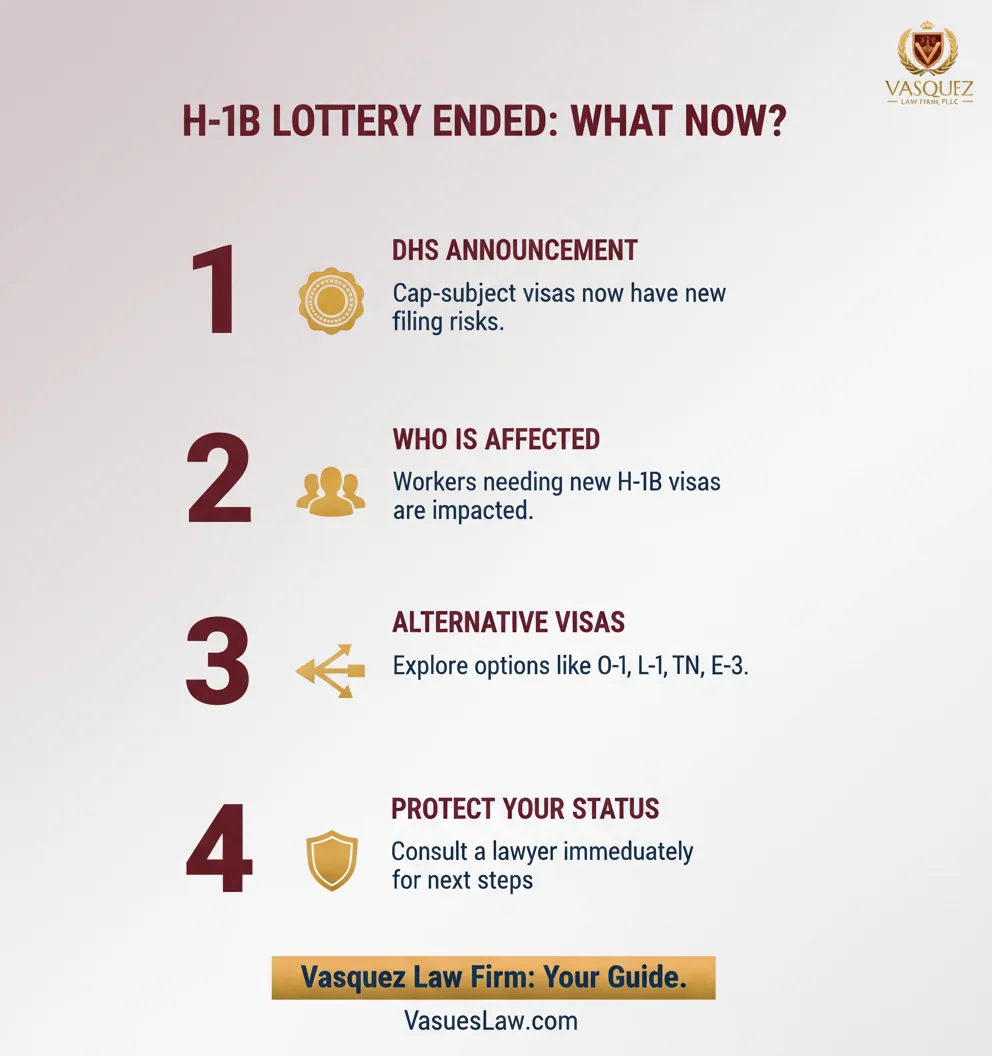
1) Lock down your current status facts
Before you react, get your timeline straight. Policy news moves fast, but your legal status is still controlled by your current approval, I-94, and employment terms.
2) Get aligned with your employer (without guessing)
If your employer is planning to file, ask who is responsible for the registration and petition strategy. Miscommunication causes missed deadlines more often than people think.
3) Build a Plan B now—not later
Many people wait until a denial or non-selection to explore alternatives. That often costs months. A fast “Plan B” review can include cap-exempt options, school enrollment timing, or other work visas depending on the facts.
If this situation applies to you, take these steps NOW:
- Step 1: Save proof of status and work authorization (I-797 approvals, I-94, EAD, passport ID page, travel history, pay stubs).
- Step 2: Ask your employer for the exact job title, worksite address, wage, and SOC code they plan to use—then keep a copy for your records.
- Step 3: Do NOT assume a “quick transfer” or “bench time” is safe; keep working only within authorized terms.
- Step 4: Consult with a legal expert to understand your rights and options
Warning Signs & Red Flags to Watch For
Employer red flags that can trigger denials or audits
Rule changes tend to come with more scrutiny. If you see these patterns, treat them as serious.
Worker red flags that can put status at risk
Even good employees can fall out of status because of paperwork gaps, travel timing, or job duty changes.
These are signs your case may be in jeopardy:
- Your employer suggests you “wait without pay,” “stay on the bench,” or work at a new location before any amendment is filed.
- Your job duties don’t match the degree field, or the offered wage looks far below what similar North Carolina roles pay.
- You’re told “the lottery is gone, so we can’t do anything,” without any discussion of cap-exempt or alternative strategies.
Seeing these signs? Vasquez Law Firm, PLLC has handled hundreds of denied claims in North Carolina. Attorney Vasquez knows the tactics insurers use. Get a free case evaluation.
Your Rights: What You CAN and CANNOT Do
Rights many H-1B/F-1 workers don’t realize they have
Even though immigration is federal, your daily work life happens locally—in offices, campuses, and job sites across North Carolina. Knowing your rights helps you avoid “quiet” violations that later become big problems.

Employer obligations that matter more during rule shifts
When enforcement goes up, documentation and consistency become critical. Small inaccuracies can lead to Requests for Evidence (RFEs) or denials.
YOU HAVE THE RIGHT TO:
- Ask for copies of key filings that affect your status (for example, petition cover pages, approval notices, and basic role details).
- Request that job duties, worksite location, and wage information be accurate and consistent across filings.
- Seek legal advice before international travel, a job change, or a major job duty change.
YOU CANNOT:
- Work outside the terms of your current authorization (wrong employer, wrong role, unauthorized side work, or unapproved location changes).
- Ignore deadlines tied to your I-94, EAD expiration, or grace periods—overstays can create long-term consequences.
Vasquez Law Firm, PLLC helps North Carolina clients understand and protect their rights every day.
Documents You'll Need (Save This Checklist)
Personal status documents
When policies shift, you often need to prove you maintained status and worked in the right role during the right dates.
Job and employer documents
H-1B cases often rise or fall on whether the job is real, specialty-level, and matches the offered wage and duties.
Gather these documents NOW (before they disappear):
- Passport (ID page + expiration), all prior U.S. visas, and travel history
- All I-797 approval notices and prior USCIS receipts
- Most recent I-94 record and entry stamps
- Pay stubs (at least the last 3), W-2s, and offer letter/job description
- F-1 records if relevant (I-20s, OPT/STEM EAD cards, SEVIS notes from your DSO)
Tip: Keep all documents organized in one folder - it makes the process much easier.
KEY TAKEAWAY:
If H-1B selection rules shift away from a simple lottery, “paper quality” matters more: consistent job duties, correct worksite details, and solid wage/supporting evidence can become the difference between approval, RFE, or denial.
Legal Background and Context
Where H-1B rules come from
H-1B eligibility comes from federal immigration law and regulations, including provisions in the Immigration and Nationality Act and Department of Homeland Security regulations. USCIS administers much of the petition process, and policy changes often appear first through updated forms, instructions, Federal Register notices, and agency guidance.
For baseline, start with the agency’s main portal: USCIS official information. For visa stamping and travel-related rules, review the U.S. Department of State visa resources.
Cap selection vs. petition approval
It helps to separate two concepts:
- Selection method (cap cases): How USCIS chooses which registrations can file petitions when there are more registrations than available cap numbers.
- Merits approval: Whether the petition is approved based on specialty occupation, wages, employer-employee relationship, worksite, and other evidence.
A change to selection rules doesn’t eliminate the need for a strong petition. In fact, it can increase scrutiny.
If things go wrong: hearings and appeals
Some immigration disputes can end up in removal proceedings or require navigating complex agency processes. The immigration court system is overseen by EOIR. Learn more at the Executive Office for Immigration Review (EOIR). North Carolina residents may interact with the Charlotte Immigration Court depending on the case posture.
Because these rules are federal, an immigration lawyer often coordinates strategy across agencies (USCIS, State Department, and sometimes EOIR) rather than focusing on just one filing.
How Vasquez Law Firm, PLLC Helps North Carolina Clients Win These Cases
Strategy built for uncertainty
News-driven changes create uncertainty, but uncertainty can be managed with planning. Serving North Carolina residents, our team focuses on building a clear timeline and a documented case file that is ready when openings appear.
Compliance-first filing (the part that prevents RFEs)
Many H-1B problems are preventable: mismatched job duties, inconsistent worksite addresses, and wage issues. We focus on consistency, evidence, and risk reduction—especially when DHS signals tighter standards.
Why experience matters
With 15 years of immigration practice, Attorney Vasquez, JD (admitted to the North Carolina State Bar and Florida Bar) has handled complex employment and family immigration matters. We also serve Spanish-speaking families—Se Habla Español.

Learn more about our Immigration Law services and the team at Attorney Vasquez.
- Step 1: We analyze your current status, deadlines, and cap exposure (including travel and I-94 risks).
- Step 2: We build an evidence plan that matches your role, wage, and worksite reality.
- Step 3: We identify alternative routes when cap strategy is unsafe (cap-exempt pathways, change of status timing, or other visa categories when appropriate).
- Step 4: If USCIS issues an RFE or NOID, we prepare a focused response tied to the legal standard—not generic documents.
Real example: “A North Carolina software professional on STEM OPT faced a tight timeline after a cap non-selection. We helped the employer restructure the plan around a cap-exempt option tied to a qualifying organization and prepared a clean, documented filing package—preventing a work authorization gap.” — Attorney Vasquez

Frequently Asked Questions (Specific to This Situation)
1) If DHS ends the H-1B lottery, will my North Carolina employer still be able to sponsor me?
Possibly, yes. Ending or changing the lottery typically means the selection method changes—not that H-1B disappears. Your employer may still sponsor you, but the best approach could shift (for example, stronger wage positioning, tighter job duty documentation, or exploring cap-exempt options depending on the employer and role).
2) I work in Raleigh on STEM OPT—should I stop working if cap rules change mid-year?
No one should stop working based solely on a headline. Your ability to work is controlled by your current authorization (EAD dates, OPT/STEM rules, and your employer’s E-Verify/STEM compliance if applicable). What you should do is confirm your expiration dates and ensure your job and reporting obligations remain compliant.
3) Could a new selection method favor higher wages, and how would that affect jobs in North Carolina?
Some policy proposals in past years discussed wage-based prioritization, but outcomes depend on final rules. If wage levels become more important, employers may need to reassess offered wages and job leveling to stay competitive. In North Carolina markets where wages vary by city and industry, accurate wage benchmarking and correct job classification become more important.
4) My employer is a hospital near Charlotte—are there cap-exempt options if cap selection becomes harder?
Some organizations and roles may qualify for cap-exempt H-1B filings (often tied to certain higher education institutions, nonprofit entities affiliated with them, or nonprofit/government research organizations). Whether a particular hospital is cap-exempt depends on its legal structure and relationships. A careful review is needed before relying on this.
5) If I travel internationally from North Carolina while an H-1B change is pending, can I get stuck?
Travel can create risks when a change of status is pending, and consular processing can add another layer of unpredictability. It’s essential to review your specific filing type, receipt/approval status, visa stamp validity, and I-94 details before traveling. In some cases, travel can convert a change-of-status request into consular processing, which changes timing and risk.
6) What if USCIS issues an RFE asking for “specialty occupation” proof under tighter standards?
Expect requests that focus on detailed job duties, degree requirements, wage level logic, and worksite evidence. Strong RFE responses usually include a duty-by-duty breakdown, proof of how the role is normally filled in the industry, organizational charts, project documentation, and credible third-party sources. Generic letters alone often don’t solve the problem.
7) Does any of this change how my case could be handled if I end up in immigration court?
Selection rules mainly affect cap filing strategy, not court procedures. But if a status problem leads to removal proceedings, your timeline and options can change dramatically. North Carolina residents may face proceedings connected to the Charlotte Immigration Court. If court becomes a possibility, you should address it early because “fixes” that work at USCIS may not be available once proceedings start.
Don't Navigate This Alone
If you're dealing with H-1B uncertainty or a possible cap-selection rule change, Vasquez Law Firm, PLLC can help. With 15+ years serving North Carolina, we know what works.
Free consultation. Bilingual team. No fees unless we win.
Call Now: 1-844-967-3536
Se Habla Español - Hablamos Su Idioma
Free Legal Consultation
Discuss your case with our experienced attorneys. We're available 24/7.
Vasquez Law Firm
Legal Team
Our experienced attorneys at Vasquez Law Firm have been serving clients in North Carolina and Florida for over 20 years. We specialize in immigration, personal injury, criminal defense, workers compensation, and family law.