criminal defense lawyer NC: WARNING—Informant Death Won’t End Case
criminal defense lawyer NC insight: a key witness’s death may NOT end your case. Learn what changes and how to protect yourself—call 1-844-967-3536.
Vasquez Law Firm
Published on December 23, 2025
criminal defense lawyer NC: WARNING—Informant Death Won’t End Case
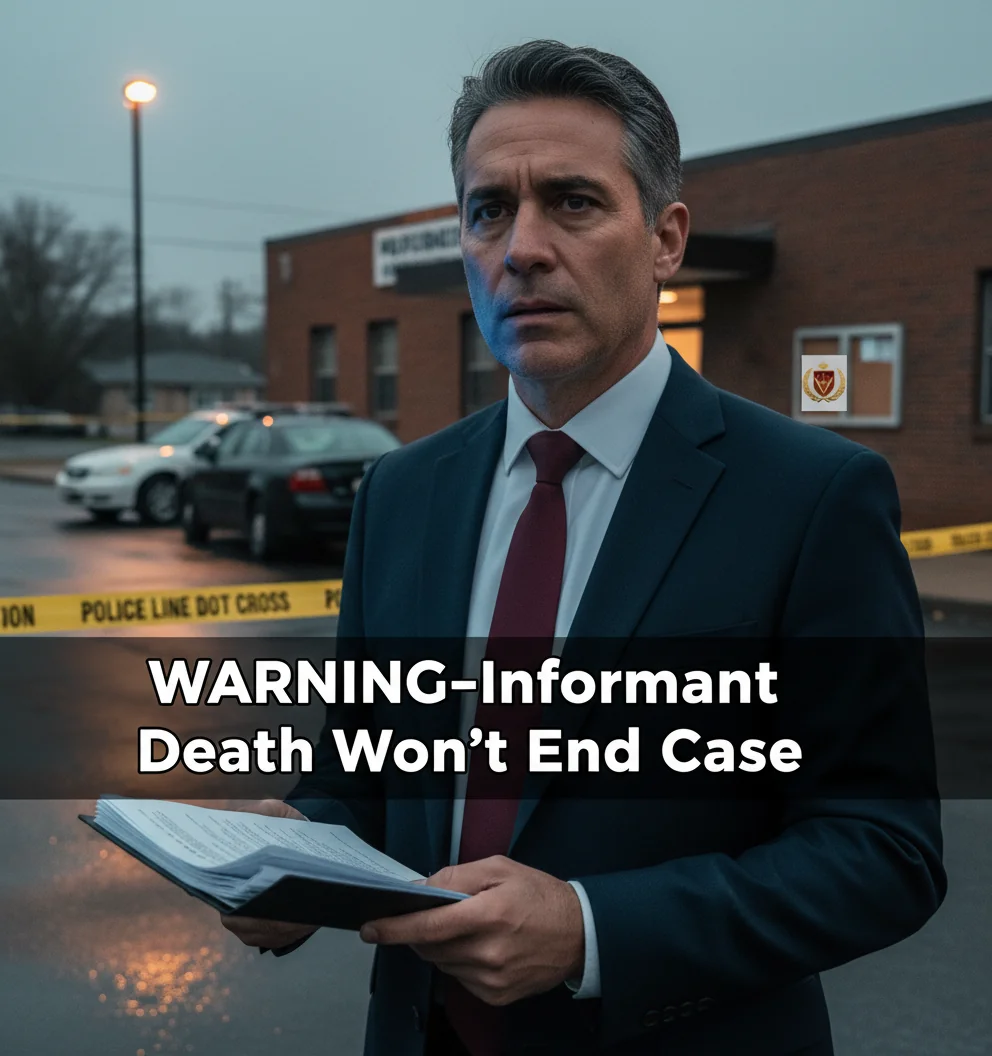
If you’re counting on a witness or informant “not being around” to make charges disappear, this news is a wake-up call. The headline out of the courts—criminal cases don’t automatically die just because an informant dies—highlights a hard truth: prosecutors often keep moving forward, and evidence can still come in. If you’re facing charges, a criminal defense lawyer NC clients trust can help you plan for what happens next in the real world, not the TV version.
Quick Summary (Read This First)
What happened: A Supreme Court decision clarified that a criminal revision/review may continue even after an informant’s death.
Why it matters to you: The same core lesson applies in North Carolina: a case can keep going even if the complaining witness or informant is unavailable, and prosecutors may rely on other evidence.
What to do now: Stop making assumptions, preserve your evidence, and get a defense plan that addresses witness-availability issues and hearsay/confrontation rules.
What This News Means for North Carolina Residents
News reports describe a Supreme Court clarification that a criminal revision won’t end just because the informant has died. You can read the summary and context in the source link.
Even though that decision comes from a different legal system, it reflects a common misunderstanding we see from people facing charges: “If the person who reported me dies, disappears, or refuses to testify, the case is over.” In many situations, that is not true.
Why cases don’t just end when a witness is gone
In most U.S. prosecutions, the “case” belongs to the State, not to the complaining witness. In North Carolina, that means the prosecutor can keep going if they believe they can prove the charge with other evidence.
That “other evidence” could include:
- Body camera video, dashcam video, or jail calls
- Physical evidence (drugs, weapons, fingerprints, DNA)
- Statements you made (including texts and social media)
- Other witnesses (neighbors, passengers, officers)
- Prior sworn testimony in limited situations
Informant vs. complaining witness: why it matters
People use “informant,” “witness,” and “victim” like they mean the same thing. They do not.
- Informant: Often a person giving tips to police, sometimes while working with law enforcement.
- Complaining witness: The person who first reports the alleged crime.
- Victim: The person harmed in an alleged offense (not every case has a clear victim).
If an informant dies, the State may still proceed using recordings, surveillance, controlled buys, officer testimony, or lab results. A criminal defense lawyer NC defendants hire will focus on challenging how that evidence was gathered and whether it can be used in court.
The dangerous assumption that “no witness = no case”
Sometimes, a witness refusing to cooperate can weaken a case. But it can also make prosecutors lean harder on:
- Hearsay exceptions (limited rules that may allow certain out-of-court statements)
- Prior testimony (if it was sworn and the defense had a fair chance to cross-examine)
- Forensic and digital evidence that doesn’t depend on a live witness
What to Do in the Next 24-48 Hours
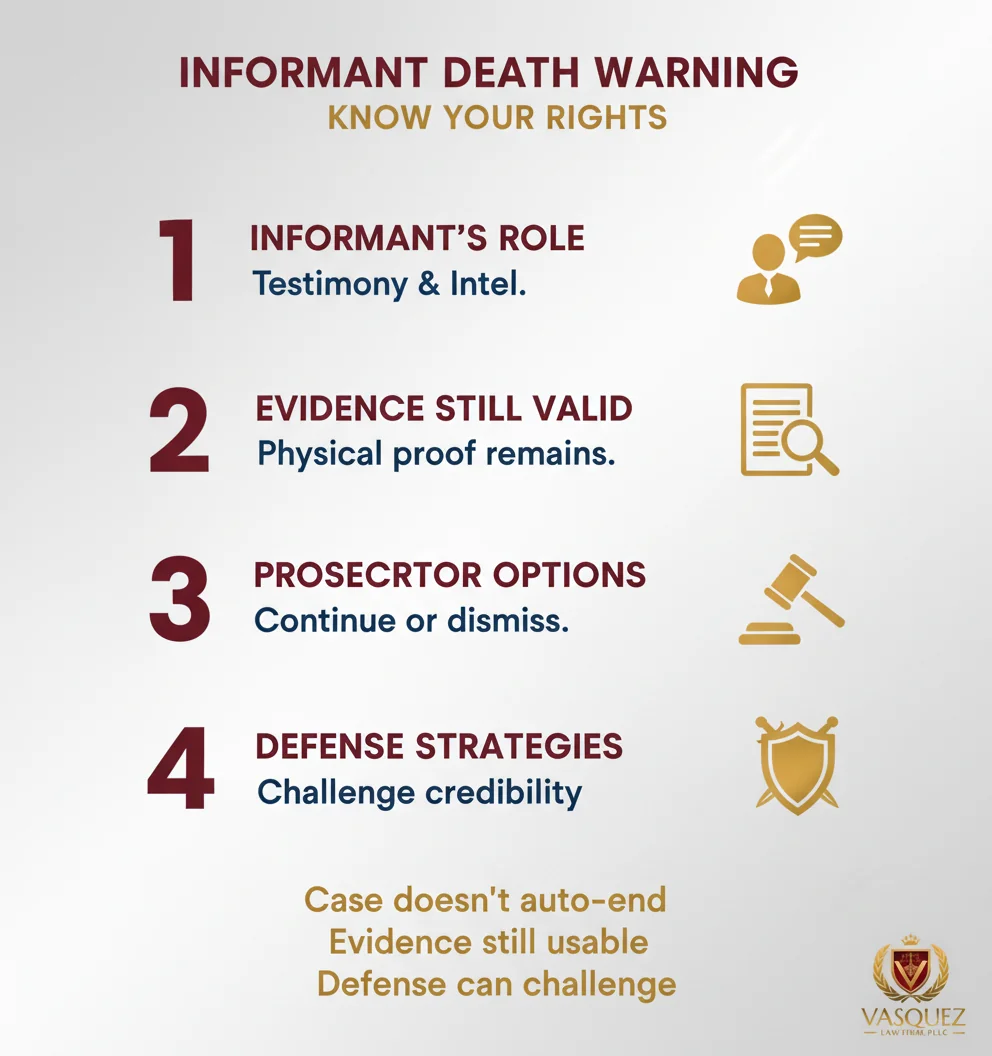
If this situation applies to you, take these steps NOW:
- Step 1: Write down a timeline while it’s fresh: dates, locations, who was present, and what was said (including texts/calls).
- Step 2: Preserve evidence you control: screenshots, messages, receipts, GPS history, and names of witnesses who can still be found.
- Step 3: Do NOT try to “handle” the witness situation yourself. Any contact can be misread as intimidation or witness tampering.
- Step 4: Consult with a legal expert to understand your rights and options
Warning Signs & Red Flags to Watch For
These are signs your case may be in jeopardy:
- Police or prosecutors tell you the case is “still moving forward” even though the witness/informant is deceased or missing.
- You learn the State has recordings, controlled-buy evidence, or bodycam video that they say replaces live testimony.
- You’re pressured to plead quickly “before things get worse,” without full discovery or review of evidence.
Seeing these signs? Vasquez Law Firm, PLLC has handled hundreds of denied claims in North Carolina. Attorney Vasquez knows the tactics insurers use. Get a free case evaluation.
Your Rights: What You CAN and CANNOT Do
YOU HAVE THE RIGHT TO:
- Remain silent and refuse police questioning (and ask for counsel) if you are a suspect.
- Challenge whether out-of-court statements can be used against you under confrontation and hearsay rules.
- Request and review discovery through your attorney, including witness statements and recordings, under North Carolina criminal procedure rules.
YOU CANNOT:
- Contact witnesses in a way that could be viewed as pressure, intimidation, or “clearing up stories.”
- Assume a case will be dismissed simply because the complaining witness is gone—courts often allow the State time to evaluate other proof.
Vasquez Law Firm, PLLC helps North Carolina clients understand and protect their rights every day.

Documents You'll Need (Save This Checklist)
Gather these documents NOW (before they disappear):
- Charging documents: citation, summons, warrant, or indictment paperwork (keep every page).
- Bond paperwork and any release conditions (no-contact orders, travel limits, testing).
- Your communications: texts, emails, DMs, call logs (export if possible).
- Media evidence: screenshots, photos, videos, and any cloud links.
- Names/contact info for witnesses who can support your timeline.
Tip: Keep all documents organized in one folder - it makes the process much easier.
KEY TAKEAWAY:
A missing or deceased witness can change the State’s strategy—but it does not guarantee dismissal. Your best move is to protect your rights early and force the State to prove every element with admissible evidence.
Legal Background and Context
To understand why a case may continue even after a witness dies, it helps to separate three issues: (1) who controls the prosecution, (2) whether statements can be used without a live witness, and (3) what happens in appeals and post-conviction review.
1) The State prosecutes most crimes, not the witness
In the U.S., prosecutors represent the government, and criminal charges are brought “by the State.” That’s why a witness can’t always “drop the charges,” and why the State can continue if it believes it has enough proof.
For North Carolina procedure and court processes, the North Carolina Judicial Branch (NCCourts.gov) provides public information on court structure, calendars, and how cases move through District and Superior Court.
2) Hearsay vs. the right to confront witnesses
Many people hear “they can’t use hearsay” and assume statements vanish when a witness is gone. In reality, hearsay rules have exceptions. Some statements may be admissible even if the original speaker cannot testify.
At the same time, the U.S. Constitution provides the right to confront witnesses in criminal cases. The Sixth Amendment is a major part of these fights, especially where the State tries to use prior statements instead of live testimony. For the constitutional text and background, see the Sixth Amendment overview from Cornell Law School.
In plain terms:
- If the State wants to use a statement that is “testimonial,” confrontation issues may arise.
- If a statement fits a recognized rule (and constitutional limits), it may still be allowed.
- Each statement is analyzed separately. A witness dying does not erase recordings, lab reports, or your own statements.
3) Discovery and evidence review in North Carolina
When a key witness is unavailable, the fight often becomes an evidence fight: What does the State have besides that witness, and was it gathered legally?
North Carolina’s criminal discovery statutes (including N.C. Gen. Stat. § 15A-903) outline what the State must disclose in many cases, such as witness statements and test results. Reviewing discovery is where a criminal defense lawyer NC defendants rely on can spot weaknesses that are not obvious at first glance.
Also, practical courtroom reality matters. In counties like Mecklenburg and Wake, prosecutors may have specialized units and well-developed evidence pipelines. If your case is in or near the Mecklenburg County Courthouse in Charlotte, you should expect the State to be organized—even when a witness problem arises.
How Vasquez Law Firm, PLLC Helps North Carolina Clients Win These Cases
When a witness or informant dies, the case usually does not “go away.” It changes shape. Vasquez Law Firm, PLLC approaches these cases by pressure-testing the State’s proof and protecting you from panic decisions.
How our defense approach targets witness-unavailability cases
Our experienced team, led by Attorney Vasquez, has helped hundreds of North Carolina clients. Here's exactly how we help:
- Step 1: We review the timeline and identify which parts of the State’s story depend on the missing witness versus independent evidence.
- Step 2: We demand and analyze discovery (recordings, reports, lab work, digital evidence) and look for legal issues with searches, seizures, and interviews.
- Step 3: We evaluate whether the State is trying to use statements that raise hearsay or confrontation problems and prepare motions where appropriate.
- Step 4: We negotiate from a position of strength—or prepare for hearings/trial if the State won’t be fair.
Why experience matters when the “main witness” is gone
These cases require careful reading and careful pacing. Prosecutors may act confident. But confidence is not proof. Attorney Vasquez, JD, brings 15 years of experience and is admitted to the North Carolina State Bar and the Florida Bar. Our team is bilingual—Se Habla Español—so you can understand the process clearly, not through guesswork.
Real example of how a witness problem can help the defense
Real example: “We represented a client accused of an offense that depended heavily on one person’s version of events. When that witness became unavailable, the State tried to rely on secondhand accounts and a short, unclear recording. We challenged the reliability and admissibility of what the State wanted to use and highlighted missing proof on key elements. The pressure shifted, and we reached a much better resolution than the first offer.” - Attorney Vasquez

Frequently Asked Questions (Specific to This Situation)
If the informant died, will my North Carolina charges be dismissed?
Not automatically. In North Carolina, the State can continue if it believes it can prove the charge through other evidence, like recordings, officer testimony, lab results, or your own statements. The defense focus is whether that evidence is admissible and strong enough beyond a reasonable doubt.
Can prosecutors use what the informant told police if the informant is dead?
Sometimes they try. Whether it’s allowed depends on the type of statement, the purpose for offering it, and constitutional limits. Some out-of-court statements may be excluded as hearsay; others may fit exceptions. Separate from hearsay, “testimonial” statements can raise Sixth Amendment confrontation issues.
What if there are recordings from a controlled buy or phone calls with the informant?
Recordings often become the centerpiece when an informant can’t testify. The key questions are authenticity (is the recording what they say it is), completeness (are parts missing), context (what happened before/after), and legality (were there constitutional violations in how evidence was obtained). Your attorney can also assess whether the State can properly explain the recording without the informant.
Does an informant’s death affect the legality of the warrant that was based on their tip?
It can, but not in the way many people expect. The main issue is what the affidavit said at the time the warrant was issued: the informant’s reliability, basis of knowledge, and corroboration. Even if the informant later dies, the defense may challenge whether the warrant had probable cause or whether material facts were omitted or misstated.
The prosecutor says “our case is stronger now” and pushes a quick plea—what should I do?
Treat that as a warning sign. A witness issue can create uncertainty for both sides, and quick-plea pressure can be a tactic. In North Carolina, your decision should come after reviewing discovery, understanding sentencing exposure, and weighing defenses. A fast plea can lock you into consequences you did not expect.
Will my court date in District Court or Superior Court change because the witness died?
It might. The State may ask for a continuance to reassess evidence, locate other witnesses, or rework its theory. Your defense can object in some situations, or agree strategically, depending on how the delay impacts your rights and your ability to prepare.
Don't Navigate This Alone
If you're dealing with charges where a key witness or informant has died or become unavailable, Vasquez Law Firm, PLLC can help. With 15+ years serving North Carolina, we know what works.
Free consultation. Bilingual team. No fees unless we win.
Call Now: 1-844-967-3536
Se Habla Español - Hablamos Su Idioma
Free Legal Consultation
Discuss your case with our experienced attorneys. We're available 24/7.
Vasquez Law Firm
Legal Team
Our experienced attorneys at Vasquez Law Firm have been serving clients in North Carolina and Florida for over 20 years. We specialize in immigration, personal injury, criminal defense, workers compensation, and family law.