criminal defense lawyer NC: The Truth About Passports & Charges
Need a criminal defense lawyer NC? The truth: pending charges don’t always block a passport—but court orders can. Learn the risks and act fast.
Vasquez Law Firm
Published on December 23, 2025
criminal defense lawyer NC: The Truth About Passports & Charges
If you have a pending criminal case and a trip coming up, you’ve probably heard a scary rumor: “You can’t renew your passport.” The recent court news about pending criminal cases ≠ automatic passport denial has people asking the same question here at home—what’s true in the U.S., and what can a criminal defense lawyer NC actually do to protect your freedom and your travel plans?
Quick Summary (Read This First)
What happened: A major court decision highlighted that a pending criminal case does not automatically mean a passport renewal must be denied under that country’s passport law.
Why it matters to you: In the U.S., many people with pending charges can apply for or renew a passport, but court-imposed travel limits, warrants, probation/parole, or federal restrictions can still stop you.
What to do now: Confirm whether your release order includes travel limits, check for any warrants/holds, and keep written proof of your next court date and compliance.
What This News Means for North Carolina Residents
Why this passport news is spreading fast
Even though the story comes from outside the U.S., the fear behind it is universal: people hear “criminal case” and assume “no passport.” The article—Pending Criminal Case ≠ Passport Denial (news report)—put a spotlight on a key idea: passport decisions should follow the actual law, not assumptions.
How the issue shows up in North Carolina cases
Serving North Carolina residents, we see this scenario often: a person has a pending DWI, assault, drug, or theft charge, and suddenly a work trip, family emergency, or planned vacation is coming up. They worry that applying for a passport will “trigger” something—or that the government will automatically reject them.
In many U.S. situations, the bigger travel problem is not the passport office. It’s the judge’s order in your case (for example, pretrial release conditions) or an outstanding warrant. If you violate travel restrictions, you can be arrested—even if you have a valid passport in hand.
Passport approval vs. permission to leave
Here’s the key distinction a criminal defense lawyer NC will focus on:
- Passport eligibility (federal administrative rules): Whether the U.S. State Department may issue/renew your passport under federal law and regulations.
- Criminal-court compliance (state court orders): Whether you are allowed to travel under your bond/release order and whether leaving could be treated as a failure to appear.
KEY TAKEAWAY:
A passport is not the same thing as permission to travel. In many cases, the court—not the passport agency—is the real gatekeeper.
What to Do in the Next 24-48 Hours
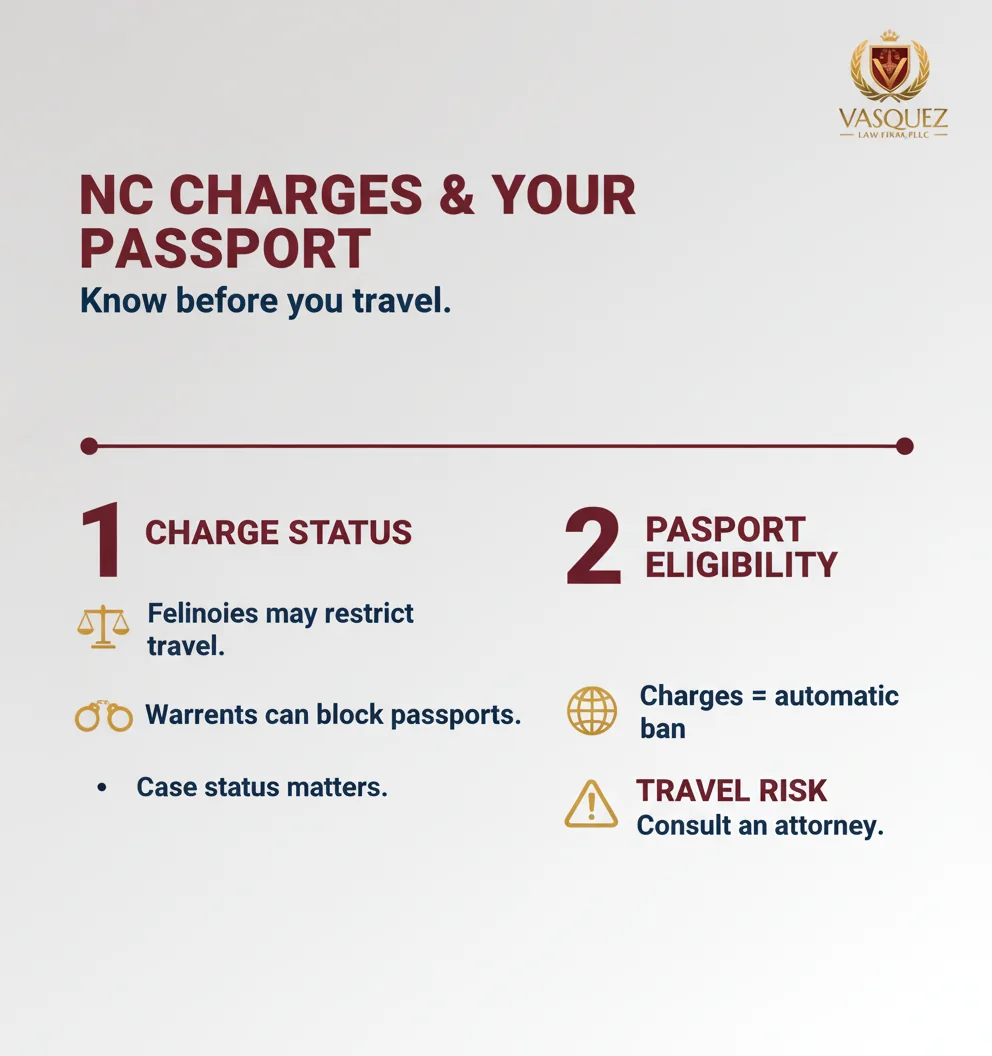
1) Read your bond/release paperwork like a checklist
If you have pending charges, your first move is to locate and read every page of your release conditions. Look for phrases like:
- “Do not leave the state”
- “Surrender passport”
- “No international travel”
- “Maintain current address” and “appear in court as ordered”
2) Confirm there are no warrants, missed dates, or holds
Passport worries often spike after a missed court date. In North Carolina, failing to appear can lead to an order for arrest. That risk is separate from passport eligibility—but it can quickly become your biggest problem.
3) Create a “proof of compliance” file
Start a folder (paper or digital) showing you are taking the case seriously. This matters if you later need the court’s permission to travel.
If this situation applies to you, take these steps NOW:
- Step 1: Find your most recent bond/release order and highlight any travel limits or passport surrender terms.
- Step 2: Write down your next court date, courtroom, and county—and set two reminders (48 hours and 24 hours before).
- Step 3: Do NOT book nonrefundable travel until you confirm you are allowed to leave (and for how long).
- Step 4: Consult with a legal expert to understand your rights and options
Warning Signs & Red Flags to Watch For
Red flag: You were told to surrender your passport (or “no travel”)
If a judge ordered passport surrender, trying to renew quietly can backfire. It can look like you’re preparing to flee—even if your reason is legitimate.
Red flag: Any missed court date, even “by accident”
One missed date can trigger a warrant, bond forfeiture, or stricter conditions. That’s when people suddenly get stopped at unexpected times.
Red flag: Your case touches federal issues (or you’re on supervision)
Probation, parole, an ICE hold, or a federal warrant can change the entire analysis.
These are signs your case may be in jeopardy:
- You have a condition of release that restricts travel or requires surrender of your passport.
- You missed (or think you missed) a court date, or you can’t confirm your next court setting.
- A clerk, bondsman, or officer tells you “there might be a warrant,” but you haven’t verified it.
Seeing these signs? Vasquez Law Firm, PLLC has handled hundreds of denied claims in North Carolina. Attorney Vasquez knows the tactics insurers use. Get a free case evaluation.
Your Rights: What You CAN and CANNOT Do
What you can usually do (passport side)
Many people with pending criminal charges can still apply for or renew a U.S. passport. The U.S. State Department publishes passport issuance rules and limitations on its site at travel.state.gov (U.S. Passports).

What you can do (court side)
You can ask the court to modify conditions in some situations. The details depend on the charge, risk factors, and your history of appearing in court.
What you cannot do without consequences
You cannot ignore a judge’s order and “just come back before court.” If the court believes you fled or tried to avoid the case, you could face arrest and new charges.
YOU HAVE THE RIGHT TO:
- Review your conditions of release and receive written notice of court dates and requirements.
- Request changes to certain bond conditions (for example, limited travel for work or family emergencies), when appropriate.
- Have counsel speak for you in court and help you avoid statements that can be used against you.
YOU CANNOT:
- Leave in violation of a judge’s no-travel order or a term requiring you to surrender a passport.
- Miss deadlines or court dates—failure to appear can trigger an order for arrest and bond consequences.
Vasquez Law Firm, PLLC helps North Carolina clients understand and protect their rights every day.
Documents You'll Need (Save This Checklist)
Court documents that matter most
If you’re trying to travel while a case is pending, your paperwork matters. Verbal “OKs” are not enough.
Passport documents and identity records
If you’re renewing, gather the standard renewal items plus anything that shows urgency (like employer letters). Follow the official passport instructions at travel.state.gov (How to Apply).
Proof you’re stable, local, and compliant
Courts often look at stability when deciding whether to loosen restrictions.
Gather these documents NOW (before they disappear):
- Your current bond/release order and any later modification orders.
- A copy of the citation, warrant, criminal summons, and any discovery you’ve received.
- Your next court date notice (or a printout/confirmation from your lawyer or the clerk’s office).
- Proof of employment, school enrollment, or caregiving responsibilities.
- Travel itinerary details (dates, locations, return plan) if you intend to request travel permission.
Tip: Keep all documents organized in one folder - it makes the process much easier.
KEY TAKEAWAY:
If you’re asking a judge for travel permission, the fastest “no” is a vague plan. Dates, return proof, and compliance records make your request more credible.
Legal Background and Context
U.S. passport limits: the short version
U.S. passports are governed by federal law and State Department rules (commonly found in 22 C.F.R. Part 51 (Passports)). A pending state criminal case does not automatically appear as a “hard stop” for every applicant.
However, there are specific legal barriers that can lead to denial or revocation in certain circumstances—such as some felony drug convictions or large child support arrears. For example, federal law can restrict passports for people with qualifying child support debt under 22 U.S.C. § 2714.
Court orders in criminal cases: the bigger travel risk
In many North Carolina criminal matters, the immediate concern isn’t federal passport law—it’s whether your release conditions allow travel. A judge can impose conditions aimed at ensuring you return to court, such as geographic limits or surrender of travel documents.
To understand local process and court structure, the official North Carolina court system resources are here: North Carolina Judicial Branch (NCCourts.gov).
Why this international news still matters here
The core lesson translates well: don’t rely on rumors. Whether you’re dealing with the State Department or a local judge, the outcome depends on the exact rule that applies to your facts. That’s why people search for a criminal defense lawyer NC when travel, jobs, and family emergencies collide with pending charges.
How Vasquez Law Firm, PLLC Helps North Carolina Clients Win These Cases
We identify the real “stop sign” (passport vs. court vs. warrant)
When someone calls worried about travel, we break the problem into parts: (1) Is there a court restriction? (2) Is there any failure to appear or warrant risk? (3) Is there a federal or supervision issue that changes everything? This is where an experienced criminal defense lawyer NC can prevent a simple travel plan from becoming a custody event.
We build a court-ready plan (not a vague request)
If a travel request is possible, we help clients prepare a clear, detailed proposal: exact dates, destination, why travel matters, how the client will remain reachable, and proof they will return.
We defend the underlying charge with travel consequences in mind
Sometimes the best “travel solution” is moving the case forward faster—addressing discovery, negotiating where appropriate, and avoiding avoidable violations that lead to stricter bond terms.

Our experienced team, led by Attorney Vasquez, has helped hundreds of North Carolina clients. Here's exactly how we help:
- Step 1: We review your situation and explain what restrictions apply (court conditions, warrants, supervision, or federal limits).
- Step 2: We organize documents and timelines so the court sees stability and compliance.
- Step 3: We address bond/travel issues proactively to reduce the risk of a violation or failure to appear.
- Step 4: We build the strongest defense strategy possible for the underlying charge, aiming to protect your record and your future options.
Real example: “We helped a client with a pending misdemeanor charge who needed to travel for a documented family emergency. The release paperwork was unclear about out-of-state travel. We gathered proof of return plans and compliance, appeared in court, and got written clarification so the client could travel without risking an arrest for violating conditions.” - Attorney Vasquez
Attorney Vasquez, JD, has 15 years of experience and is admitted to the North Carolina State Bar and the Florida Bar. Se Habla Español.

Frequently Asked Questions (Specific to This Situation)
Can I renew my passport in North Carolina if I have pending criminal charges?
Often, yes. A pending charge by itself does not automatically block a U.S. passport renewal in every case. The bigger issue is whether your court conditions restrict travel or require passport surrender, and whether you have any warrants or supervision terms that change your status.
What if the passport office denies my application because my case is pending?
If you receive a denial, read the denial reason carefully and keep the letter. Denials typically cite a specific basis (for example, a statutory restriction, incomplete documentation, or another issue). A pending state case alone is not always the stated reason; sometimes the real problem is identity documentation, child support certification issues, or confusion caused by overlapping records.
My bond says “don’t leave the state”—does that mean I can’t even apply for a passport?
A “no travel” bond condition is a court order. Applying for a passport is not the same as crossing a border, but it can be misunderstood if the court believes you’re preparing to flee. If your bond includes travel restrictions or passport surrender language, get legal advice before taking steps that could be misread.
I have a pending DWI in NC—can I still travel internationally if I get the passport?
Even with a valid passport, you can still violate court conditions if you leave without permission. Also, other countries control entry at their borders; some may refuse entry based on arrest history, convictions, or the purpose of travel. The safest approach is to confirm your release terms and, if needed, seek a written modification before you go.
Does it matter if my pending case is in Wake County vs. Mecklenburg County?
The basic legal framework is statewide, but local practices can differ (how quickly bond motions get heard, how judges handle travel requests, and scheduling realities). The most important factor is your specific judge’s order and your compliance history—not just the county name.
What if the court already made me surrender my passport—can I request it back for a short trip?
Sometimes, courts will consider a temporary release for a documented purpose with a clear return plan, but it depends on the charge severity, prior record, flight risk concerns, and upcoming court dates. If the court previously required surrender, you should assume the issue is sensitive and needs a careful, documented request.
What if I’m not a U.S. citizen and my NC criminal case is pending?
This can change everything. Non-citizens may face immigration consequences from arrests and charges, and travel can trigger additional screening on return. If you have a pending case and any immigration concern, you need a coordinated strategy so you don’t accidentally create a second legal crisis at the airport.
Don't Navigate This Alone
If you're dealing with pending criminal charges and passport/travel restrictions, Vasquez Law Firm, PLLC can help. With 15+ years serving North Carolina, we know what works.
Free consultation. Bilingual team. No fees unless we win.
Call Now: 1-844-967-3536
Se Habla Español - Hablamos Su Idioma
Free Legal Consultation
Discuss your case with our experienced attorneys. We're available 24/7.
Vasquez Law Firm
Legal Team
Our experienced attorneys at Vasquez Law Firm have been serving clients in North Carolina and Florida for over 20 years. We specialize in immigration, personal injury, criminal defense, workers compensation, and family law.