criminal defense lawyer NC: The Truth About Pending Charges & Passports
Criminal defense lawyer NC explains when pending charges can block passport renewal—and how to protect travel plans. Questions? Call 1-844-967-3536.
Vasquez Law Firm
Published on December 23, 2025
criminal defense lawyer NC: The Truth About Pending Charges & Passports
A headline about a Supreme Court ruling overseas sparked a big question here at home: if you have a pending criminal case, can the government “quietly” stop you from renewing your passport? In North Carolina, the answer is more nuanced than most people think—and the wrong move (like violating a court order or probation term) can turn a travel problem into a custody problem. This post breaks down what a criminal defense lawyer NC looks for when passports, pending charges, and court restrictions collide.
Quick Summary (Read This First)
What happened: A Supreme Court decision highlighted that a pending criminal case doesn’t automatically mean passport renewal must be denied.
Why it matters to you: In the U.S., pending charges may not automatically bar a passport, but court orders, probation, warrants, or federal restrictions can still stop you—or expose you to arrest risk when you travel.
What to do now: Confirm whether any judge has restricted travel, check for warrants/FTAs, and don’t make travel plans until you understand the specific limits in your case.
What This News Means for North Carolina Residents
Why a foreign passport ruling matters in North Carolina
The article that sparked this conversation discusses how a court viewed passport renewal rights even when a criminal case is still pending (see the news coverage about pending criminal cases and passport renewal rights). While that decision was not in the United States, it highlights a common misunderstanding: many people assume “pending charges = no passport.”
The North Carolina reality: the passport office isn’t your only problem
For many people in North Carolina, the larger risk is not the passport agency—it’s the criminal court. Judges can restrict travel as a condition of pretrial release, require surrender of a passport, or treat out-of-state travel as a violation of bond conditions.
That’s why a criminal defense lawyer NC will usually start by looking at your bond paperwork, any release order, and whether you have any upcoming court dates that could be missed due to travel.
The biggest myth: “If they let me apply, I’m safe to travel”
Even if you successfully renew a passport, traveling can still be dangerous if:
- You have a missed court date (FTA) and a warrant was issued.
- Your release conditions forbid leaving the state or country.
- You are on probation or post-release supervision with travel limits.
In other words, the passport is just one piece of the puzzle. A criminal defense lawyer NC focuses on the full risk picture: passports, warrants, release conditions, immigration consequences, and what happens if you try to return through an airport.
What to Do in the Next 24-48 Hours
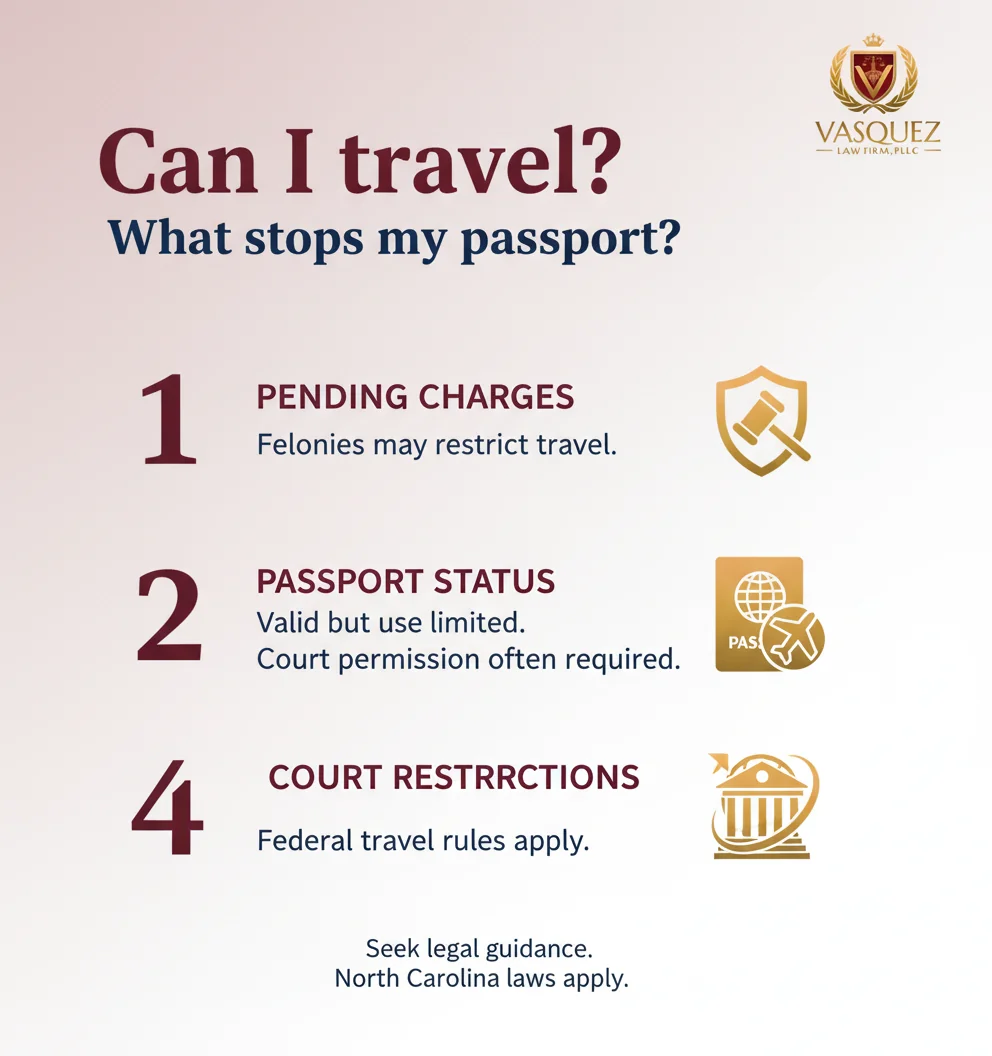
1) Pull your latest court paperwork (don’t rely on memory)
People often remember what they think the judge said—but what matters is what the order says. Get a copy of your:
- Conditions of pretrial release (bond conditions)
- Any order requiring passport surrender
- Any written “no travel” or “stay in county/state” language
2) Verify you do not have a warrant or missed date
If you missed a court date—even by accident—you may have an outstanding order for arrest. Before you travel, confirm your case status through official sources (and don’t depend on “my cousin checked online”). For general court information and resources, see the North Carolina Judicial Branch (N.C. Courts).
3) Learn the federal passport “stop signs” that apply in the U.S.
U.S. passport issuance/denial is controlled by federal rules. Pending charges alone often are not an automatic bar, but certain circumstances can trigger denial or limitations. The U.S. State Department provides public guidance on passports and requirements at travel.state.gov (U.S. Passports).
If this situation applies to you, take these steps NOW:
- Step 1: Get copies of your bond conditions, any release order, and your next court date notice (screenshots are not enough—save the PDFs or certified copies).
- Step 2: Confirm whether any warrant/FTA exists and whether the judge has restricted travel (county, state, or international).
- Step 3: Do NOT book nonrefundable travel until you know if the court must approve the trip in writing.
- Step 4: Consult with a legal expert to understand your rights and options
Warning Signs & Red Flags to Watch For
Red flags in bond conditions (the “hidden travel ban”)
Many people sign release paperwork quickly and don’t notice travel language. The restrictions may appear under “conditions” rather than using the words “travel ban.”
Red flags on probation/post-release supervision
Probation often requires permission to leave the state, and international travel can be prohibited or require advance written approval. A violation can lead to detention even if the underlying criminal case is still pending.
Red flags tied to the passport process itself
Even when you can renew, certain legal issues can trigger extra review or complications (for example, child support arrears or specific federal drug-related restrictions).
These are signs your case may be in jeopardy:
- Your bond paperwork says you must stay in the county/state, or it requires court permission to travel.
- You missed (or might miss) a court date because of a trip, work travel, or an emergency.
- You were told to surrender your passport, or the clerk/judge mentioned “no international travel.”
Seeing these signs? Vasquez Law Firm, PLLC has handled hundreds of denied claims in North Carolina. Attorney Vasquez knows the tactics insurers use. Get a free case evaluation.
Your Rights: What You CAN and CANNOT Do
What you CAN do (common lawful options)
In many cases, you can take steps to protect your freedom and your travel plans—but you must do it the right way.
What you CANNOT do (common mistakes that backfire)
Some “quick fixes” create new charges or bond violations. That can make your original case much harder to resolve.

YOU HAVE THE RIGHT TO:
- Ask the judge to modify bond conditions so you can travel for work, medical care, or family emergencies (when appropriate).
- Apply for or renew a U.S. passport unless a specific legal restriction applies (court order, warrant, federal ineligibility categories, etc.).
- Have your attorney communicate with the DA/court and request written permission or a clear order—so you are not relying on verbal comments.
YOU CANNOT:
- Ignore travel limits in your bond/probation terms—leaving anyway can lead to arrest and new bond conditions (or revocation).
- Miss court and assume you can “fix it later”—an FTA can trigger an order for arrest and complicate passport/travel issues.
Vasquez Law Firm, PLLC helps North Carolina clients understand and protect their rights every day.
Documents You'll Need (Save This Checklist)
Court and release documents
These show what you are allowed (and not allowed) to do right now.
Passport and identity documents
These help you avoid delays and reduce the risk of mistakes that can slow the process.
Proof for a travel permission request
If you need a judge’s permission, you’ll usually need evidence showing why the travel is necessary and how you will return.
Gather these documents NOW (before they disappear):
- Your latest bond/conditions of release paperwork and next court date notice.
- Any order mentioning passport surrender, travel restrictions, house arrest, or electronic monitoring.
- A copy of the citation, warrant, indictment, or criminal summons (what you are charged with matters).
- If requesting travel permission: work letter, medical records, funeral notice, itinerary, and proof of return date.
- Passport application/renewal materials (receipt, tracking, and any written correspondence from the passport agency).
Tip: Keep all documents organized in one folder - it makes the process much easier.
KEY TAKEAWAY:
For many defendants, the biggest travel risk isn’t “passport denial”—it’s a bond/probation violation or an FTA. The safest plan is to confirm restrictions in writing before you leave.
Legal Background and Context
1) U.S. passport rules: when the federal government can deny or limit a passport
In the United States, passport issuance is governed by federal statutes and regulations. A pending criminal case by itself is not always a listed reason for denial, but several related factors can trigger problems, such as:
- Outstanding warrants or unresolved court orders
- Specific federal ineligibility categories (for example, certain drug trafficking convictions can affect passport eligibility)
- Serious child support arrears (a federal certification process can result in denial until resolved)
For public-facing guidance on passport rules and processes, review official information at travel.state.gov. For the regulatory side, passport denial/limitations are addressed in federal regulations such as 22 C.F.R. § 51.60 (Cornell Law School’s Legal Information Institute).
2) North Carolina bond conditions: why judges can restrict travel
In North Carolina, pretrial release can come with conditions designed to ensure you return to court and protect public safety. Even if your case seems “minor,” the judge can still impose travel limits, especially when there are concerns about failure to appear or out-of-state ties.
Practical point: travel restrictions are often enforced through bond revocation, increased secured bond, or an order for arrest if you miss court. That is why a criminal defense lawyer NC will read the release conditions line-by-line before giving travel advice.
3) Airport returns and “surprise” consequences
Even if you leave without incident, returning through an airport can expose unresolved issues. If a warrant exists or you violated conditions, you can be taken into custody. If you are not a U.S. citizen, international travel can also trigger immigration screening and additional consequences.
This is one reason people with pending charges should not treat travel as “just a passport question.” It is a court-compliance question too.
How Vasquez Law Firm, PLLC Helps North Carolina Clients Win These Cases
We audit your case for travel risk (not just the charge)
Our team looks beyond the accusation and checks the issues that commonly derail travel plans: bond terms, warrants, probation conditions, and court calendars. When you work with a criminal defense lawyer NC, you want someone who thinks two steps ahead—because travel mistakes can create leverage for the prosecution.
We request clear court orders (so you’re not guessing)
When appropriate, we can ask for a bond modification or written permission to travel, supported by documentation. Clear language matters. “I thought I was allowed” is rarely a good defense to a bond violation allegation.
We build the defense strategy with real-world consequences in mind
Travel issues often connect to the broader defense plan—timelines, negotiations, compliance, and credibility with the court. Vasquez Law Firm, PLLC approaches these cases as a full strategy problem, not a quick paperwork task.
Our experienced team, led by Attorney Vasquez, has helped hundreds of North Carolina clients. Here's exactly how we help:

- Step 1: We review your case for free and tell you honestly if you have a claim
- Step 2: We handle all paperwork and deadlines so nothing gets missed
- Step 3: We fight insurance tactics - we know their playbook
- Step 4: We maximize your settlement or take it to hearing if needed
Real example: “We represented a client in Mecklenburg County who had a pending misdemeanor charge and an upcoming international family emergency. The client’s release paperwork had a travel restriction that wasn’t obvious at first glance. We gathered documents, requested a targeted bond modification, and obtained clear written permission with return dates—helping the client avoid an FTA and preventing a bond violation that could have triggered custody.” - Attorney Vasquez
Attorney Vasquez, JD, is admitted to the North Carolina State Bar and the Florida Bar, with 15 years of experience. Se Habla Español.
Frequently Asked Questions (Specific to This Situation)
Can I renew my passport in NC if I have pending DWI charges?
Sometimes, yes. A pending DWI does not automatically mean the passport office must deny renewal. But your bond conditions (or probation terms from another case) can still restrict travel. Also, if you miss a DWI court date in North Carolina because you are traveling, the resulting FTA/warrant can quickly turn into an arrest risk. A criminal defense lawyer NC will typically review your release order and court calendar before you finalize travel.
What if the passport office delays or denies my renewal because my criminal case is pending?
First, read the denial or delay notice carefully and keep a copy. Delays can happen for identity verification, documentation issues, or federal eligibility flags that are not about your pending charge at all. If the notice cites a legal basis, an attorney can help you understand whether it’s tied to a warrant, a court order, child support certification, or another federal rule.
Can a North Carolina judge make me turn in my passport?
Yes. Courts can impose conditions designed to prevent flight risk. In practice, a judge may order you to surrender a passport, avoid applying for a passport, or restrict international travel as part of pretrial release conditions. If you violate that order, the court can tighten bond conditions or order your arrest.
Does this work differently in Wake County vs. Mecklenburg County?
The federal passport rules are the same everywhere, but local practices can differ on bond conditions, how travel requests are handled, and what documentation a judge expects. In both counties (and across North Carolina), the safest approach is to obtain clear, written permission when travel is restricted.
If I renew my passport, will it “alert” the court or police about my pending case?
Renewing a passport is not the same thing as turning yourself in, but it can create a record that may matter if other issues exist (like an outstanding warrant). The bigger issue is that travel itself can expose a warrant at an airport screening or during any law enforcement contact. If there is any chance you missed court or have an FTA, address that first.
What if I’m on probation in North Carolina while my new charge is pending?
That combination is high-risk. Probation often has travel limits and reporting requirements, and a new charge can trigger violation proceedings. Even if a passport is technically valid, leaving without permission can lead to detention or sanctions. This is a situation where a criminal defense lawyer NC should review both the probation terms and the new case’s release conditions together.
I’m not a U.S. citizen—does international travel with pending charges create extra risk?
Yes. Noncitizens can face added screening at reentry, and criminal charges can affect admissibility and immigration status depending on the facts. Even if the criminal court allows travel, immigration consequences may still exist. Get advice that considers both systems before you leave the country.
Don't Navigate This Alone
If you're dealing with pending criminal charges, bond conditions, or passport-related travel restrictions, Vasquez Law Firm, PLLC can help. With 15+ years serving North Carolina, we know what works.
Free consultation. Bilingual team. No fees unless we win.
Call Now: 1-844-967-3536
Se Habla Español - Hablamos Su Idioma
Free Legal Consultation
Discuss your case with our experienced attorneys. We're available 24/7.
Vasquez Law Firm
Legal Team
Our experienced attorneys at Vasquez Law Firm have been serving clients in North Carolina and Florida for over 20 years. We specialize in immigration, personal injury, criminal defense, workers compensation, and family law.